

Let’s start this with a little deviance. What is deviance? It is a fact or state of diverging from usual or accepted standards.
Now, why are we concerned about this in aviation? We are very procedural and safety conscious, so we love to stick to tried, true, standard and safe procedures. I am sure our passengers love us for this as well. Aviation, as with a lot of other fields, must be at the top of its game in order to prevent harm or death. We know that when we deviate it can have serious consequences but quite often, we are confronted with minor little deviances and end up flying anyway as we have learnt (either from actual lessons, mentoring or just previous experience) that this is a safe practice.
Examination, in general terms, of some well-known incidents will help highlight where we may be able to re-examine our own practices. You can also look up these examples online for further detail.
Space Shuttle Challenger
The solid rocket boosters had O-rings sealing some joints and a design goal was for no joint failures. It was known that the joint material could erode and some blow-by could result, but these were accepted as risks and waivers in the design goals were received. It was seen that if this was to eventuate then the “secondary should catch it” and thus the mission continued. On the night before launch day it was quite cold, and ice was formed on some areas. Although the engineers cautioned that these temperatures were outside the design parameters the mission was given a green light. The result after launch was blow-by that ended with an explosion of the shuttle and the deaths of all seven crew.
Space Shuttle Columbia
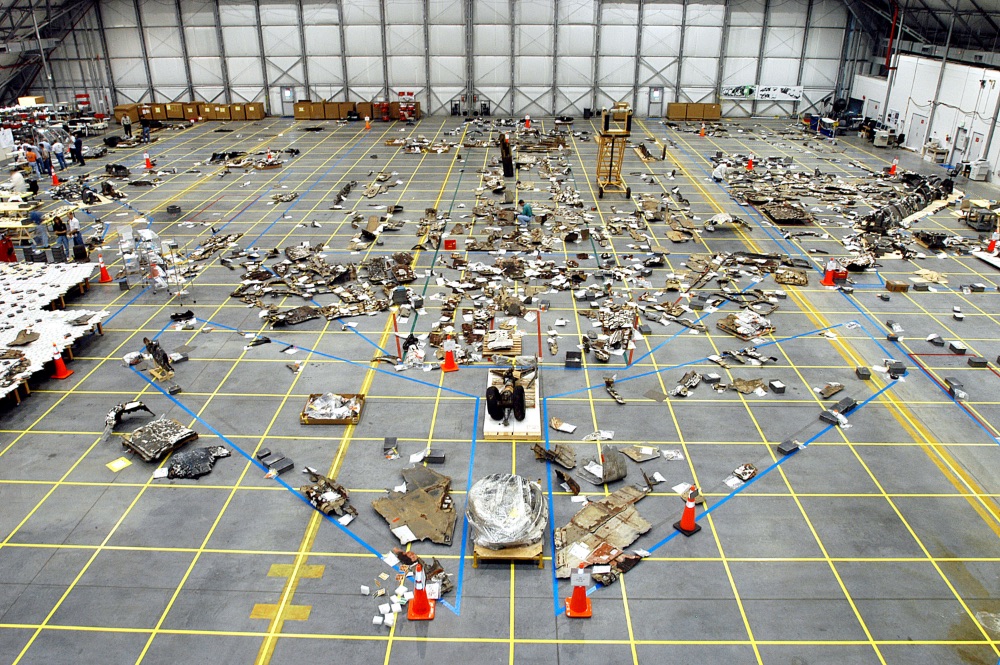
The insulating foam covering the external fuel tank was known to shed on occasion, but this was seen as a maintenance issue rather than a safety-of-flight issue despite observed damage and the design goal of no foam loss. Foam strikes to the orbiter were accepted risks due to the decreased likelihood of any damage being done in the unlikely instance that foam did shed, and shed in just the right direction, and cause any damage that would decrease safety. In the end, all of these did eventuate and the resultant damage to the orbiter caused it to explode on re-entry with, again, the loss of all crew.
Costa Concordia
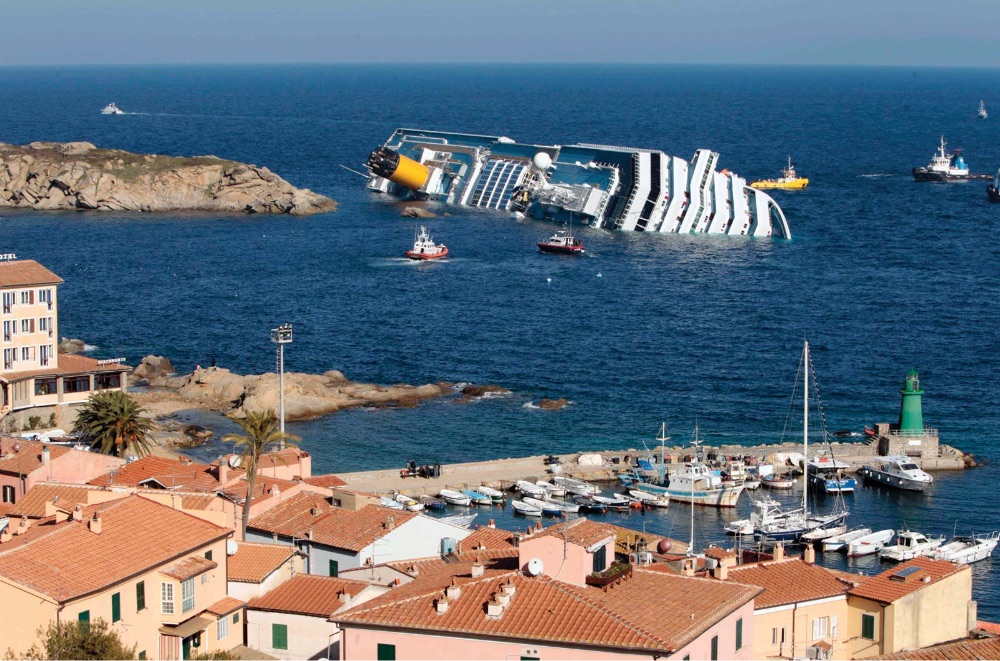
This cruise ship had previously been ordered by the company to do a sail past salute at Isola del Giglio, Italy, due to celebrations. The captain had since done several other passes at the same location. On the day in question the ships Maitre D’hotel was on the bridge as he was from the island, as was the girlfriend of the captain. The captain turned off alarms as “he knew the area and had been there 3 or 4 times before”. This time resulted in the ship running aground and 32 lives lost.
International Space Station (ISS).
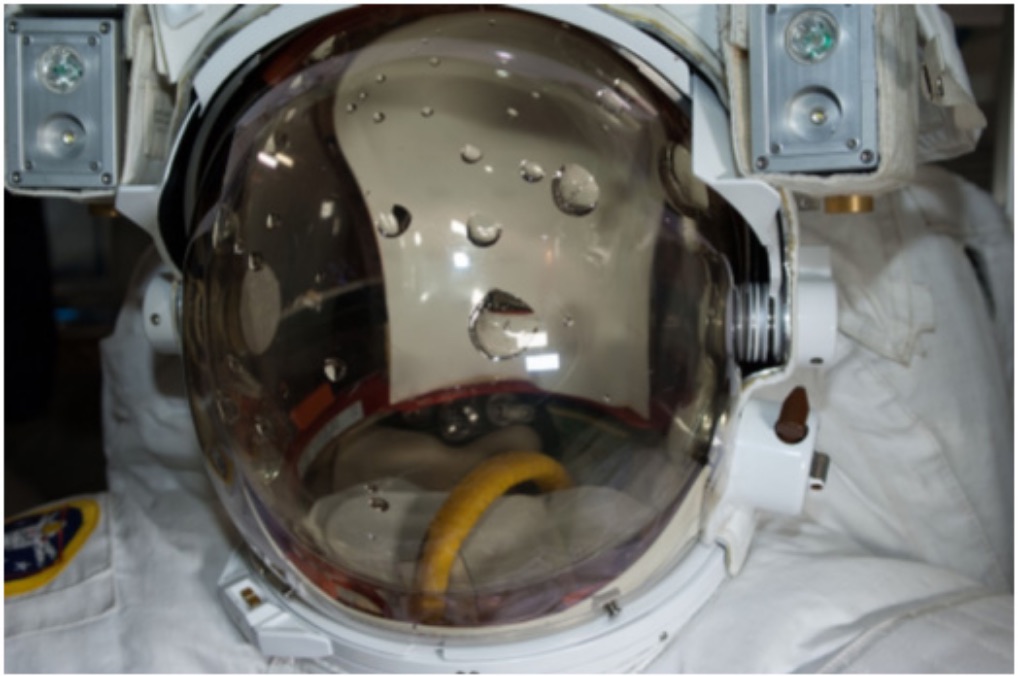
The drink bags inside space suits had been known to leak on the ISS so water was observed in space suits during Extra-Vehicular Activity (EVA) – i.e. ‘spacewalks’. On this occasion (ISS EVA-23) water was again observed in the space suit but the assumption was it was just a leaking drink bag again. This time, though, it was a leaking vent loop so was much more serious and resulted in the astronaut nearly drowning.
So, what is Normalisation of Deviance?
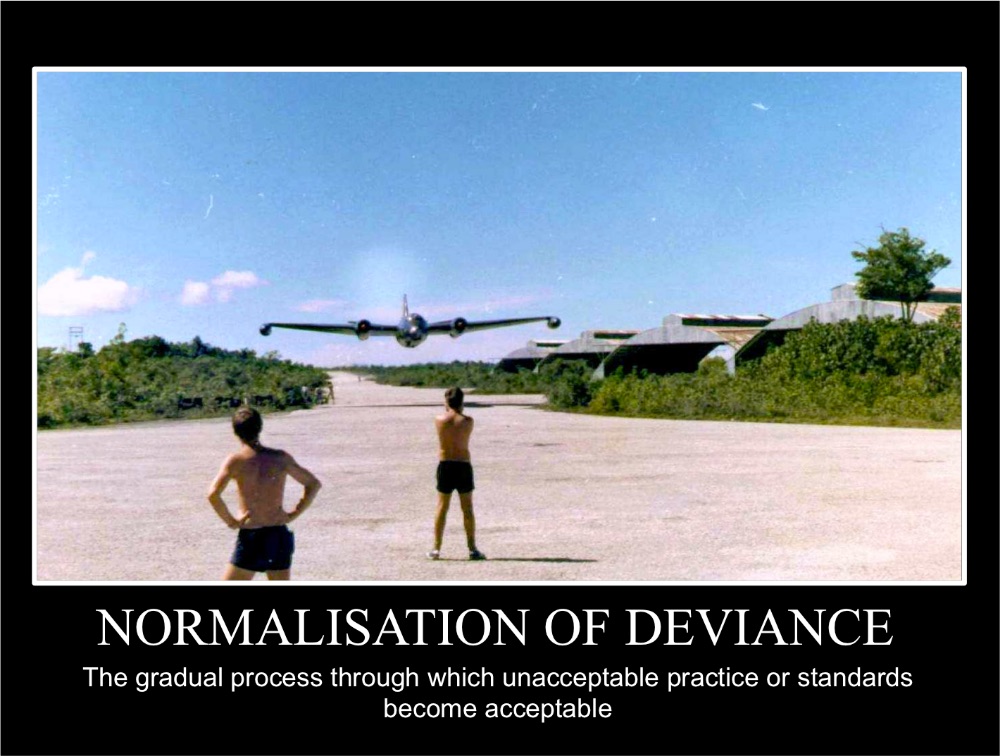
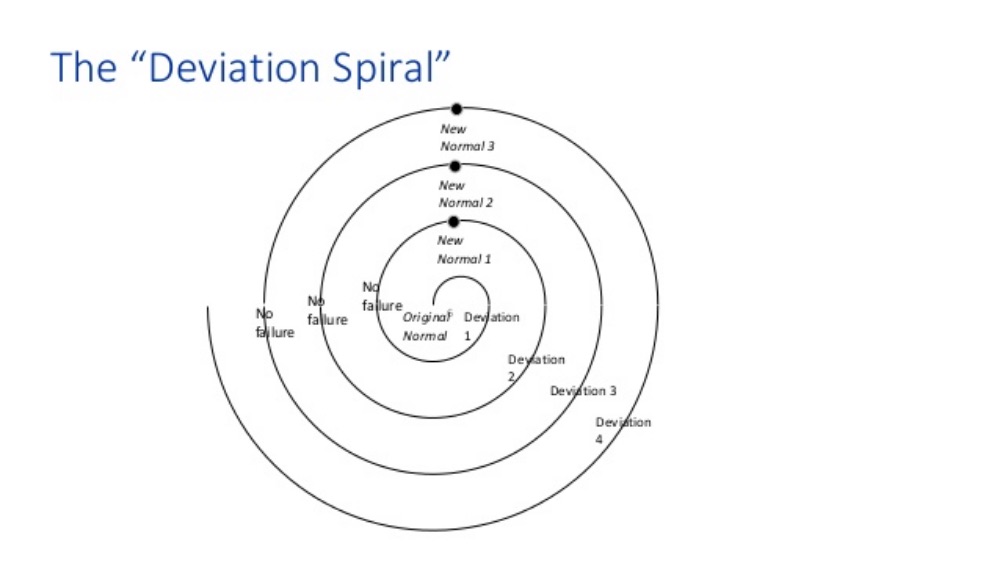
The process of normalisation of deviance can be seen in the “Deviation Spiral” where you can see a deviation from the original normal causes a new normal which, again, can be deviated from, causing another normal. Each of these deviances need only be small but the gradual acceptance of each, and subsequent “getting away with it” teaches us that the deviance is acceptable – until an incident occurs.
The 80% Rule is an instructional example of normalisation of deviance where a student will generally only learn 80% of what they are being taught. When an expert teaches a lesson then the student will not reach the same standard as that expert at the conclusion of that lesson. In this form of normalisation of deviance both students and instructors accept the ‘new normal’ for many reasons. You can probably recount your own examples where a subject matter expert has taught an authority/officer/senior-instructor who takes on board 80% of that teaching. They, in turn, now teach other instructors who now only learn 80% of that teaching so are at 64% of the original. When these instructors teach the students, those students now only take on 51.2% of the original teachings. If you add in another layer of either more junior instructors or social learning around the hangar then you, as the final student in the chain, may only learn 40.96% of the original instruction.
Another contributing factor to this is “Groupthink” which is “…a quick and easy way to refer to a mode of thinking that persons engage in when they are deeply involved in a cohesive in-group, when concurrence-seeking becomes so dominant that it tends to override critical thinking or realistic appraisal of alternative courses of action.” (Irving l. Janis, 1982). This leads people to want to be part of the group more than voicing individual critical thought or it can lead to a minority voicing critical thought to be overruled within the group or for them to conform to remain part of the group.
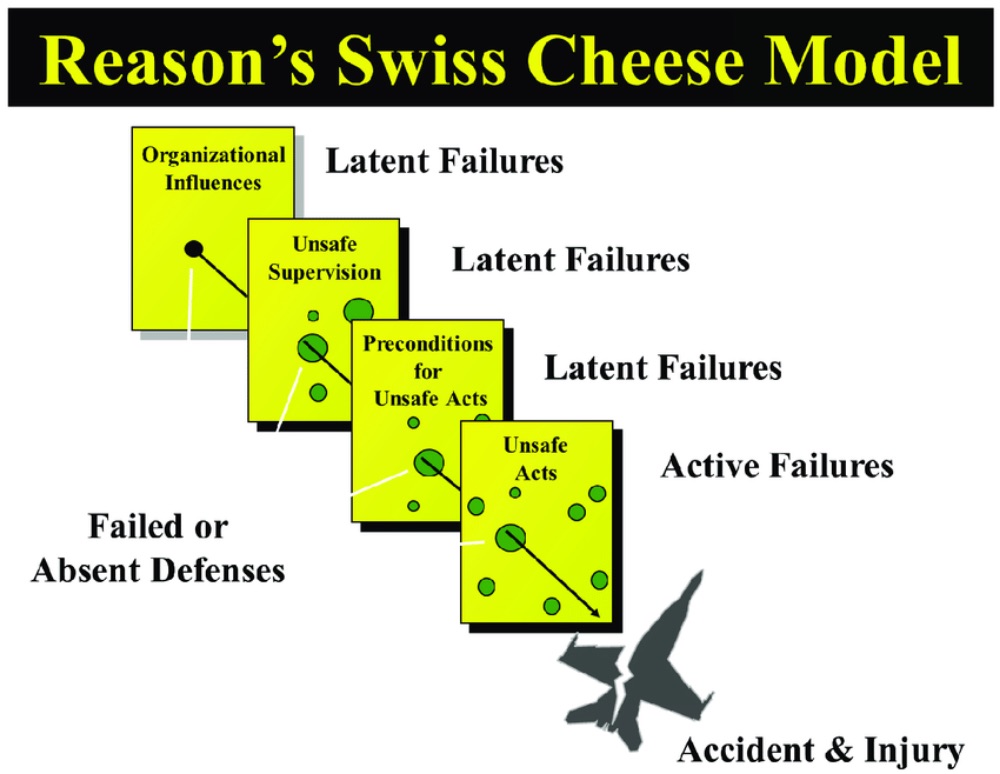
The above is all great as background learning but we need to examine the implications of this. Most of you are probably already ahead of me when I mention James Reason or the Swiss Cheese model. We have all read accident/incident reports where this has come up or have at least been taught about it in some area of your life. The model describes the chain of an accident as many little deviances that, by themselves, are small but if all those little ‘holes in the swiss cheese’ line up then the result can be disastrous. The model also shows, importantly, that if one of us just turns one slice of that swiss cheese around then the holes will not align, and a disaster can be averted.
Let me pose a few questions to get you thinking:
- Have you ever departed on a flight (or drive) with the taillight not working and a “I’ll fix that when I get home” attitude?
- If the required distance below cloud is 500’ (i.e. Australian Class D) and the cloud has been reported at 1300-1400’ above the ground, have you ever gone out and done some circuits at 1000’?
- Have you ever been a teacher or student where the teaching was done to a budget?
- Have you ever continued with an unstabilised approach?
Hopefully you can view examples such as these and others from your own experience considering the things described above. If you are able to reflect on these and correct any errors or deviances, then you will have achieved the aims of this article – avoidance of the normalisation of deviance and the critical thinking and evaluation of performance.
Critical thinking and objective evaluation of performance is a great step toward solving these problems and then avoiding any normalisation of deviance or groupthink and I urge you all to do it in any area of your lives. Once the two space shuttle disasters had been analysed NASA came up with some key recommendations which were:
- Don’t use past success to redefine acceptable performance.
- Require systems to be proven safe to operate to an acceptable risk level rather than the opposite.
- Appoint people with opposing views or ask everyone to voice their opinion before discussion.
- Keep safety programs independent from those activities they evaluate.
These were replicated in Flight Safety Australia May 2017
What I would like to see now is you self-reflecting on how any of this information will impact on your practice. If you have heard it before will you critically evaluate your use of this information as well as your performances? If the information is new to you will you develop habits to critically evaluate your own performance? Will you say no when it is needed? Will you allow a simple little item that you have known about for ages stop you from flying now?
Adam Starr is an instructor and examiner who has been teaching in adult education since the 1980s. He specialises in adult education, flight instruction and testing and particularly in instrument flight in technologically advanced aircraft. He has over 1500 hours of instrument instruction and over 2500 hours instructing in Cirrus aircraft. Adam was Australia’s first Cirrus factory certified Platinum CSIP and has been training within the Cirrus factory training network for over 10 years. You can contact him at or on 0412469247.